


Not everyone reading about UX research today is a researcher. Some readers are experienced UX researchers looking to sharpen a specific method. Others are product managers, designers, or founders who just lost research support — or never had it — and need to know how to validate decisions without a research team backing them up.
The right book depends a lot on which of those groups you're in. So instead of one generic list, each pick below comes with a quick note on who it's actually for — whether that's deep research methodology, or a practical way to start finding UX problems without a research background.
Start testing in minutes and get results within hours. Tap into our pool of 170k+ testers and watch videos of users interacting with your product on their devices. Discover what’s working for your product, and what’s not!
Start your free trialA quick note before the list: Userbrain has not been paid to promote any of these books. The following is simply a selection — not an exhaustive one — of some of the most useful UX research books available right now.
1. "Just Enough Research" by Erika Hall
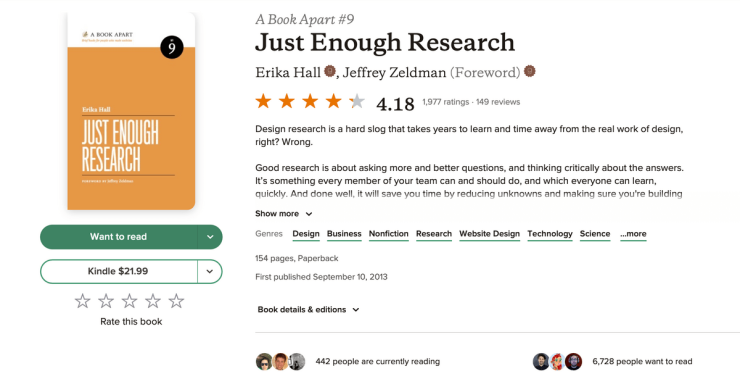
Best for: teams without dedicated research support, and anyone who thinks "research" sounds bigger and more intimidating than it needs to be.
Erika Hall's Just Enough Research demystifies the idea that design research is a daunting, time-consuming task only accessible to experts. Hall, co-founder of Mule Design, presents a compelling argument for integrating research into every stage of the design process, rather than treating it as a separate discipline handled by specialists.
The book offers a concise overview of research methods that are both accessible and immediately applicable, regardless of your project's scale or budget. It covers everything from framing the right questions to running lightweight studies and interpreting what you find, without requiring prior training.
The book has been updated twice since its original 2013 release — a second edition in 2019 added a chapter on surveys, and a newer 2024 edition (published under Hall's own Mule Books imprint) refreshes it further. Hall's emphasis on critical questioning and identifying bias makes this an especially useful resource for anyone trying to make decisions that genuinely reflect what users need, rather than what the team assumes they need.
2. "The User Experience Team of One" by Leah Buley (and Joe Natoli)
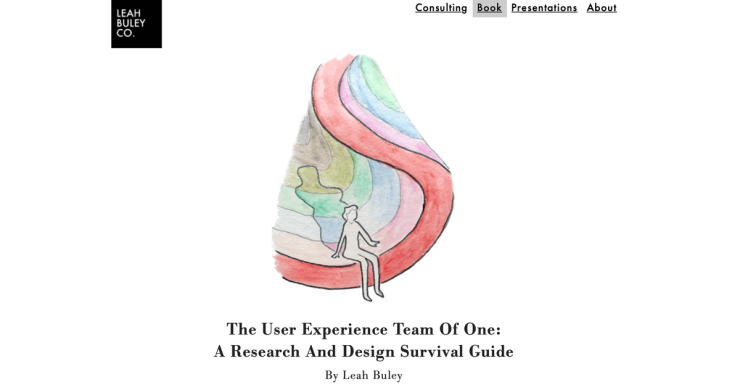
Best for: solo practitioners and small product teams doing UX work without a formal research function around them.
Leah Buley's The User Experience Team of One is a survival guide for people navigating the challenges of limited resources and time constraints — a description that fits most product teams today, not just designated "UX teams." The book has become something of a classic, recommended by figures like Steve Krug of Don't Make Me Think.
The second edition, published in 2024, was co-written with Joe Natoli and updated with a decade's worth of new material to reflect how the UX landscape has changed since the original. It offers a range of approaches that are efficient and effective, from starting a UX program with no budget or headcount, to gaining organizational support, to running lightweight testing and research practices day to day.
The book is built around doing more with less, with concrete tools, templates, and a "if you can only do one thing" takeaway at the end of each chapter — which makes it one of the more practical picks on this list for anyone building a testing habit without dedicated research support.
3. "Continuous Discovery Habits" by Teresa Torres
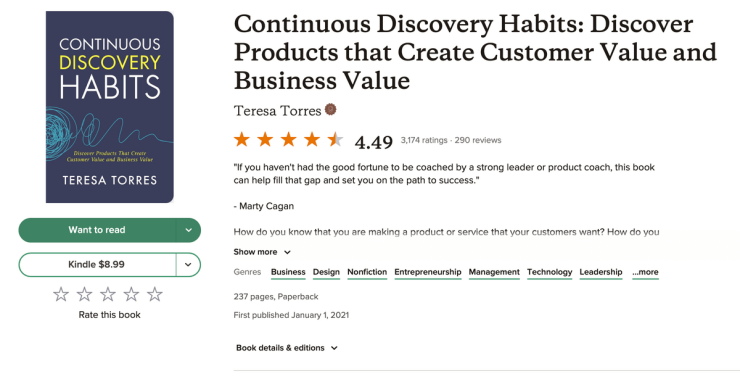
Best for: product managers and product teams who want a repeatable habit of talking to users, not a one-off research project.
Teresa Torres' Continuous Discovery Habits is a widely cited guide that bridges the gap between building products that resonate with customers and achieving measurable business outcomes.
Praised by industry leaders including Marty Cagan, the book introduces a structured approach to continuous discovery — small, frequent touchpoints with users woven into the regular product cadence, rather than large studies run only before major releases. Torres combines research, real case studies, and years of coaching experience to provide advice that teams can put into practice immediately.
It's particularly relevant for teams that currently only test when they ship a feature: the core argument is that UX and product risk don't wait for release cycles, so validation shouldn't either. That makes it a strong fit for product managers and designers looking to build an ongoing discovery habit rather than treat testing as a occasional project.
4. "Think Like a UX Researcher" by David Travis and Philip Hodgson
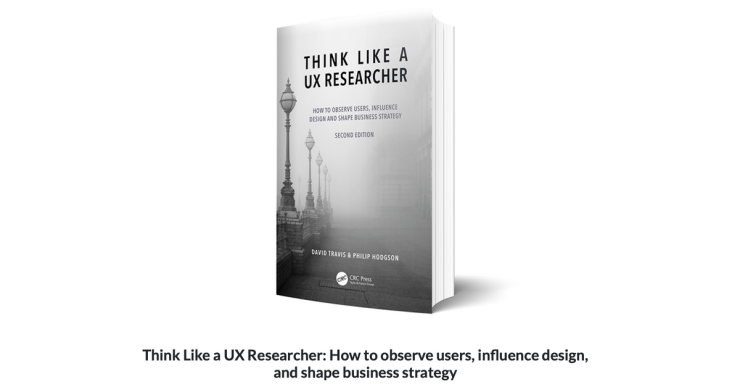
Best for: people who already run tests regularly and want to go deeper into research methodology and how UX research has changed in practice.
Think Like a UX Researcher: How to Observe Users, Influence Design, and Shape Business Strategy by David Travis and Philip Hodgson challenges readers to broaden their understanding of UX research beyond conventional methodologies, encouraging a more strategic approach to optimizing the user experience at every touchpoint, not just isolated screens or flows. Both authors hold PhDs in Experimental Psychology and have decades of hands-on research experience between them.
The second edition, published in 2024, adds six new essays covering how UX research methods have shifted in recent years — including a case against relying solely on remote methods, and guidance on handling difficult stakeholders. The book is structured as essay-style segments covering planning, conducting, and analyzing research, plus persuading teams to act on results and building a UX career.
Because it leans more methodology-heavy than the other books on this list, it's best suited to readers who already have some research experience and want to sharpen how they think about evidence and stakeholder buy-in, rather than readers looking for a first introduction.
5. "Building the Research Engine" by Julian Della Mattia
Best for: researchers and research leads trying to make research a reliable, ongoing function rather than a series of one-off studies.
Julian Della Mattia's Building the Research Engine: A Guide for Organizations That Want to Know, Not Guess is a very recent addition to this list — a self-published first book by a researcher and research-operations consultant with over a decade of experience building research practices from scratch across startups and scale-ups.
Importantly, this is explicitly not a methods book: it assumes you already know how to run a study. What it covers instead is everything around that — the systems, culture, and communication infrastructure that determine whether research actually reaches the people making decisions. Della Mattia walks through three stages: getting research to happen consistently, connecting it to real product decisions, and making it self-sustaining enough that it doesn't depend on one person.
Because it's brand new and self-published rather than an established industry reference, it's worth treating as a fresh, practitioner-written perspective on research operations rather than a long-standing classic — but for research leads specifically wrestling with getting insights actually used inside their organization, it's one of the few books tackling that problem directly.
6. "Measuring the User Experience" by Tom Tullis and Bill Albert
Best for: anyone who needs to back up UX findings with numbers, especially when presenting to stakeholders who want data, not anecdotes.
Measuring the User Experience: Collecting, Analyzing, and Presenting UX Metrics by Tom Tullis and Bill Albert is the standard reference for quantitative UX research, now in its third edition. It won the Textbook and Academic Authors Association's Textbook Excellence Award in 2024, and has been recommended by figures like Jakob Nielsen and Steve Krug since its first edition.
The book walks through choosing the right metrics, designing studies that produce statistically sound results, and analyzing and presenting that data credibly. The third edition expanded its coverage of behavioral and physiological metrics, splitting them into dedicated sections on eye-tracking and measuring emotion, along with new case studies and examples.
It's denser and more methodical than most other books on this list, closer to a reference text than something read cover to cover in a weekend. For teams that regularly need to defend a UX decision with hard numbers rather than qualitative observations alone, it remains one of the most frequently cited books in the field.
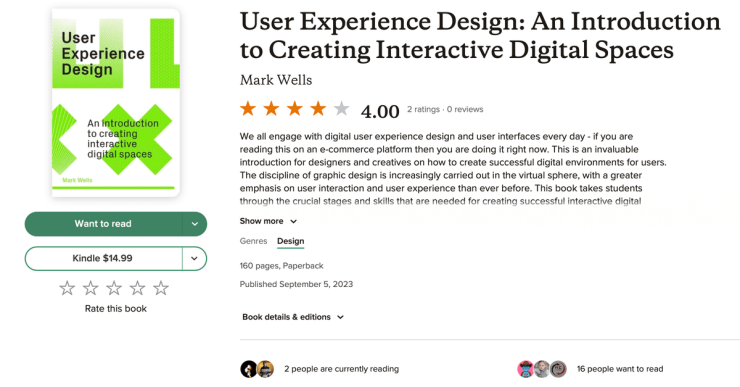
7. "User Experience Design" by Mark Wells
Best for: designers and newcomers who want a broad foundation before specializing.
Mark Wells, a Senior Lecturer at the University of Brighton, presents a foundational overview in User Experience Design: An Introduction to Creating Interactive Digital Spaces, guiding readers through the process of crafting engaging digital environments from the ground up.
This book serves as a valuable resource for designers and creatives eager to master the fundamentals of digital UX design. Wells navigates through essential stages such as data collection, user analysis, testing, and prototyping, ensuring readers are equipped to create seamless designs for varied devices and platforms.
With visual examples and case studies drawn from a range of industries, this book works well as a broad entry point for anyone who is new to UX research and design and wants context before diving into more specialized or methodology-heavy books like the ones above.
A practical alternative if you don't have time for 300 pages
Books are excellent for building a foundation, but they take time — and if the immediate goal is simply to run a first test and find out where users are struggling, reading a full research book isn't always the fastest way to get there.
Userbrain's own book, How User Testing Actually Works in Practice, was written by Markus Pirker, Stefan Rössler, Andreas Riedmüller, and Mathias Placho, based on more than ten years of hands-on experience. In the book's own words, the main reason for writing it was the belief that product teams should take user testing into their own hands — while acknowledging that hiring an external usability expert for an independent analysis can still make sense at times.
The book is explicit about what it isn't, too: it's not about running statistically comparable usability studies, and it doesn't cover writing formal usability reports for clients. Instead, it's structured around three practical parts: why user testing matters and why you don't need to be an expert to start, a step-by-step guide to running tests yourself (from selecting participants to sharing results), and a library of ready-to-use test scenarios for things like e-commerce sites, SaaS products, and prototypes.
It's a practical companion to the more research-focused books above, aimed squarely at product managers, designers, developers, and founders who want to start testing continuously without first becoming — or hiring — a research specialist. The full book is available to read for free directly on Userbrain's site.
Wrapping Up: The Best UX Research Books for 2026
Which of these books is "best" depends less on the book and more on where you're starting from. Researchers scaling a research function will get more out of Building the Research Engine or Measuring the User Experience. Product teams and designers without dedicated research support will likely get more immediate value from Just Enough Research, The User Experience Team of One, or Continuous Discovery Habits.
Either way, reading about UX research is only useful if it leads to actually testing with real users. That's the step that turns theory into fewer bad releases and fewer surprised users.
Your next step – start researching!
Start your Userbrain free trial – test your product with real users in minutes! 🚀
Book a call – to get advice from our in-house user testing experts 👋