


Deciding between moderated and unmoderated UX testing is a practical decision based on your research goals, professional expertise, and available resources. Rather than a mere methodological preference, it is a choice of efficiency: matching the depth of insight you need with the time you have available.
Start testing in minutes and get results within hours. Tap into our pool of 180k+ testers and watch videos of users interacting with your product on their devices. Discover what’s working for your product, and what’s not!
Start your free trialThe reality of the decision is straightforward:
-
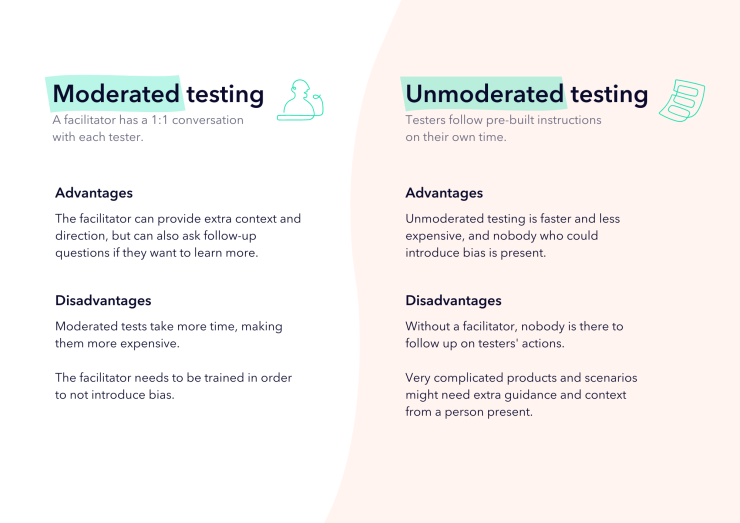
Moderated testing is the ideal choice if you are an experienced researcher with the necessary time and budget. It allows for deep-dive qualitative exploration and real-time follow-up.
-
Unmoderated testing is the strategic choice when you are short on time, working with limited resources, or are less experienced with formal testing protocols.
In many cases, unmoderated testing follows the Pareto principle: you can capture roughly 80% of the core usability insights with only 20% of the effort required for moderated sessions.
Let's break down exactly when to use each method and how to maximize your results.
What is Moderated Usability Testing?
Moderated usability testing is defined by the active presence of a facilitator who observes the participant in real-time. Unlike a product demonstration (where an expert might guide a user through features) a moderated test remains a neutral observation. The moderator's role is to set the stage, provide necessary background context, and observe how the user navigates the product independently.
While unmoderated testing is highly efficient for most scenarios, the moderated approach is specifically valuable when the research requires immediate, spontaneous probing. It allows the researcher to ask follow-up questions the moment a participant hesitates or expresses a thought that wasn't anticipated in a pre-written script.
-
Contextual Complexity: If a project requires specific background information or a complex scenario that is difficult to convey through text instructions alone, a moderator can ensure the participant stays within the intended research boundaries.
-
Spontaneous Probing: While both moderated and unmoderated tests reveal the "why" behind user actions through spoken protocols, moderated sessions allow you to dig deeper into unexpected behaviors as they happen.
-
Early-Stage Exploration: When you are still defining the problem space and don't yet know which specific questions to ask in a structured script, the flexibility of a live session is an advantage.
Key Benefits of Moderated Testing
- Deep qualitative insights: You can ask "why?" in real-time and explore unexpected user behaviors
- Flexibility to adapt: If a participant struggles or discovers something you hadn't anticipated, the moderator can pivot and explore further
- Rich contextual understanding: Body language, tone, and hesitation patterns provide layers of insight beyond words
When Moderated Testing Makes Sense
Choose moderated testing when you're at the early stages of design, testing prototypes that aren't self-explanatory. It's particularly valuable for:
- Exploratory research where you're still defining the problem space
- Complex workflows that require guidance
- Accessibility testing where participants may need support
- Situations where you want to capture emotional reactions and non-verbal cues
The catch? Moderated sessions are time-intensive and resource-heavy. You're limited by how many sessions you can personally facilitate, and scheduling can become a logistical puzzle.

This method shines when you're working with high-fidelity prototypes or complex interfaces that need explanation.
The moderator uses techniques like the think-aloud protocol, where participants verbalize their thoughts as they navigate your product. This real-time narration reveals not just what users do, but why they do it.
What is Unmoderated Usability Testing?
Unmoderated usability testing takes a different approach. Participants complete tasks independently, following written instructions, while software records their actions and feedback. No facilitator is present, so users navigate your product at their own pace, in their own environment.
Why Unmoderated Testing Works
Unmoderated testing has become the industry standard for agile development teams due to its unique combination of speed, authenticity, and logistical ease.
-
Rapid Results (Speed): The most significant advantage is the turnaround time. Because there is no need to coordinate schedules between a moderator and a participant, you can launch a study and begin reviewing results within hours. This allows UX teams to keep pace with fast-moving sprint cycles.
-
Scalability and Potential for Quantitative Data: Unmoderated testing scales effortlessly. While most usability studies focus on small groups (3–5 participants) to find the most glaring issues, the unmoderated format allows you to easily increase your sample size to dozens or hundreds of users. This scalability provides the potential to gather statistically significant quantitative data, such as task completion rates and time-on-task, should your research goals require it.
-
Authentic User Behavior: Without a moderator present, the "observer effect" is minimized. Participants interact with your product in their natural environment, using their own devices. This leads to more authentic behavior and a more realistic representation of the user experience.
-
Logistical and Cost Efficiency: By removing the need for a live facilitator, you also remove the calendar Tetris, overheads, lab rentals and time-zone coordination. This makes continuous, iterative testing financially and operationally viable.
-
On-Demand Access to Vetted Testers: Platforms like Userbrain provide immediate access to a massive pool of vetted, ready-to-go testers. While the recruitment technically happens the moment you order, the groundwork of vetting and managing the panel is already handled, allowing you to bypass the traditional, weeks-long recruitment process.
The Structured Advantage
The true power of unmoderated testing lies in its standardized, repeatable format. Unlike the fluid and semi-structured nature of moderated sessions, unmoderated tests follow a rigid script that ensures every participant encounters the exact same experience.
As UX researcher Marc Busch highlighted in a recent webinar, this is the power of a structured approach: because every participant receives the exact same words in the exact same sequence, there is no risk that a moderator, who may phrase things slightly differently from session to session, inadvertently skews the results. In moderated research, each finding requires checking what was said before it to understand what prompted the user's response. At scale, that becomes unmanageable. In unmoderated testing, you can rely on your data with much greater confidence, because the conditions are always identical.
This structure also makes the resulting data uniquely "AI-ready." Because the sessions follow a consistent prompt-response pattern, AI analysis tools can make sense of the data, identify recurring themes, and summarize findings far more effectively than they can with the unpredictable conversations of moderated research. What's more, while "think-aloud" protocols can naturally slow a user down and skew time-on-task metrics, a structured approach excels at pinpointing where users get bogged down. By testing at scale, researchers can quickly determine if a sticking point is a systemic design flaw rather than an anecdotal outlier.
Beyond data analysis, the unmoderated method offers a hugely practical advantage when comparing designs. Its low cost and high speed make it the ideal choice for testing multiple iterations simultaneously, bypassing the logistical hurdles involved with scheduling separate moderated rounds for every version. Unmoderated testing allows teams to observe how their product performs across real-world devices, whether phone or tablet, Android or Apple, with ease. By removing barriers (i.e. the costs or scheduling complexity that come with remote moderated sessions), teams can achieve a more refined view of UX in its natural environment.
Head-to-Head Comparison: Cost, Speed, and Effort
Let's get practical. Here's how moderated and unmoderated testing stack up across the dimensions that matter most to your project:
| Factor | Moderated Testing | Unmoderated Testing |
|---|---|---|
| Cost | Higher (facilitator time, scheduling) | Lower (automated, scalable) |
| Speed | Slower (1–2 weeks typical) | Faster (results in 24–48 hours) |
| Sample Size | Typically Small (5–10 participants) | Typically Small (But scales easily to 20+) |
| Insight Depth | Deep to very deep (Real-time follow-ups, spontaneous probing) | Medium to deep (Standardized observations) |
| Flexibility | High (adapt in real-time) | Lower (fixed task flow) |
| Setup Effort | Moderate (script + scheduling) | Low (Rapid setup; no scheduling required) |
| Analysis Effort | Medium to high (AI tools like Dovetail can help, but less structured data requires more careful review) | Lower (automated metrics + AI analysis) |
The Budget Reality
With unmoderated testing, the cost per participant drops significantly because you are removing the overhead of work-hours and scheduling. This shift doesn't just save money; it changes how often you can afford to test. Instead of saving your budget for one massive "event" at the end of a design cycle, unmoderated testing makes it possible to run smaller, iterative tests every week. This high-frequency approach ensures that user feedback is integrated into every stage of development, preventing costly design pivots later in the process.
While moderated testing carries a higher price tag per session, its value lies in the ability to probe deeper into unexpected user behaviors in real-time. However, it is a misconception that emotional cues (perhaps a frustrated sigh or a confused pause) are exclusive to moderated sessions. Both methods capture these vital qualitative insights. The real budget decision isn't about the depth of the insight, but about whether your project requires a live moderator to ask follow-up questions or if your goal is to observe natural user behavior across a wider range of participants.
Timeline Considerations
Working under tight deadlines? Unmoderated testing delivers. You can launch a test in the morning and have preliminary results by evening. Moderated sessions require coordination, finding times that work for both facilitator and participant, conducting hour-long sessions, and reviewing recordings. However, if you're in the discovery phase and time isn't your primary constraint, moderated sessions provide the space you need to explore.
The Decision Matrix: Which Method Suits Your Project?
Focus on what truly matters: matching your method to your research goals. Here's a practical framework:
Choose Moderated Testing When:
- You are a seasoned user researcher and can confidently guide sessions without inadvertently leading participants.
- The study instructions themselves are intricate and require a guide.
- You are in a new problem space and don't know which questions to ask yet.
- You are testing with domain experts or users with specific accessibility needs.
- You need the ability to pivot the interview based on unexpected user responses.
Choose Unmoderated Testing When:
- You have a prototype or live feature and want to see natural, unguided interaction.
- Your timeline requires results within hours to keep the design sprint moving.
- You need feedback from a global audience across different time zones.
- You need to quickly share "highlight reels" of user issues to justify design decisions.
- You are running A/B tests or benchmarking against competitors.
The Project Stage Factor
Think of your design process as a funnel. At the top, during discovery and ideation, moderated testing helps you explore the full possibility space. As you narrow solutions down, unmoderated testing validates your choices with data from real users at scale.
For continuous testing throughout development, unmoderated methods let you quickly check if small design changes work as intended.
AI-Powered Analysis: Transforming Input into Actionable Insights
The traditional sore point of usability testing can be found in the hours spent drafting tasks and analyzing recordings. Helpfully, this has been transformed by AI. Rather than replacing the researcher, AI functions as a high-speed research assistant that handles the heavy lifting of data processing, allowing you to focus on making those big decisions.
How AI Solves the Blank Page Syndrome
Every researcher knows the paralysis that can grip you at the thought of a new study. Where do you begin? What questions will yield the most insight? An AI-powered platform such as Userbrain helps you to formalize and auto-generate tasks. By inputting your research goals, the AI suggests structured tasks and questions, which you then refine with your domain expertise. This partnership ensures your study is methodologically sound from the very first click.
From Messy to Tidy: The Data Transformation
As mentioned earlier, in a recent webinar, UX expert Marc Busch highlighted the concept of "Tidy Data." AI performs best when it has structured, consistent input. This is where unmoderated testing has a massive advantage over moderated sessions. Because every participant in an unmoderated test follows the exact same instructions in the same order, the resulting data is highly structured.
The key advantage isn't simply that AI can tag or transcribe sessions, it can do that for moderated and unmoderated tests alike. The real difference lies in the consistency of the input. Because every participant in an unmoderated test receives the exact same tasks in the exact same order, there is no risk of moderator-introduced variation. That means you can rely on patterns across sessions without needing to scrutinize the context of every individual response. In moderated research, you always have to ask: what did the moderator say that might have prompted this? In unmoderated testing, that question disappears, and AI analysis becomes dramatically more reliable as a result.
The Human-AI Partnership
The most effective research treats AI as a force multiplier. You define the strategy and the "problem space," while AI handles the pattern recognition and initial analysis. This is particularly powerful for unmoderated testing, where you can process 20+ sessions in minutes, a task that would traditionally take days of manual review.
Crucially, good AI analysis doesn't just surface insights, it shows you the data behind each one. You can always see exactly which participant said or did something, and jump directly to that moment in the session recording. That's the principle behind Userbrain's AI analysis: to deliver insights as fast as possible, while making it as easy as possible to trace every finding back to its original source. You remain the expert who validates the findings and decides which insights will redirect the design approach.
The 80/20 Rule: Why Unmoderated Testing is Often All You Need
In UX research, the most sophisticated strategy isn't necessarily the most complex. While many advocate for a hybrid approach, the reality for most fast-moving teams is adhering to the 80/20 rule, in which unmoderated testing provides 80% of the critical qualitative insights for about 20% of the effort and cost of moderated sessions.
It is a common industry myth that you need a live moderator to uncover the 'why' behind user behavior or to conduct 'discovery' research. In practice, unmoderated testing is a powerful tool for both. Because participants are in their natural environment, interacting with your product without the pressure of an observer, you often see more authentic behavior and hear more candid feedback.
Before Userbrain, John Oman, Head of Design at Starling Minds, led a team that struggled with the time-consuming process of recruiting participants for testing. Unmoderated, remote testing with real people changed everything, garnering results in hours instead of weeks: "What struck me with Userbrain is that it was just super easy to use. It was super easy to get your tests going. Saves time. It's the best." Read more here.
Efficiency Without Sacrificing Depth
Choosing unmoderated testing doesn't mean settling for so-called 'shallow' data. With the right task design, which can be auto-generated and refined using Userbrain's AI, you can uncover everything from deep-seated usability issues to mental model mismatches, and plenty besides.
-
Discovery & Hypothesis Generation: You can run unmoderated tests at the very start of a project to explore how users currently solve a problem.
-
The "Vetted Pool" Advantage: With access to a pool of 180k+ vetted testers, the friction of recruitment is removed. You aren't just finding anyone, you are accessing a pre-screened audience ready to provide high-quality verbal feedback within hours, not weeks.
-
Continuous Insight Loops: For mature products, unmoderated testing allows for a weekly rhythm of feedback. This high-frequency "pulse" is often more valuable than a deep-dive moderated study conducted only once a quarter.
When to Consider Moderated Testing
Moderated testing remains a powerful option in specific situations. For the right researcher, a well-run moderated session can surface insights that no other method can, the kind of nuanced, in-the-moment discoveries that emerge from genuine human conversation. A skilled moderator can follow a thread that wasn't in the script, explore an unexpected emotional reaction, or gently guide a participant through an experience complex enough to require real-time support. If you're a professional user researcher with strong facilitation skills, there are edge cases where moderated testing is simply irreplaceable.
That said, those edge cases are narrower than many assume. For highly confidential or unreleased hardware, or extremely complex non-linear enterprise workflows that require active guidance, moderated testing is often the right call. But for the vast majority of digital product development, unmoderated testing provides the qualitative depth and speed required to make informed design decisions daily.
Your Next Steps: From Insight to Action
The choice between moderated and unmoderated testing isn't about choosing between depth and speed. It's about matching your method to the complexity of your test setup and required turnaround time.
If you are scratching your head about certain user behavior or wondering why a prototype is being tricky, unmoderated testing is your most efficient path to the answer. It provides the same qualitative answers as moderated sessions but at a fraction of the operational overhead. By leveraging Userbrain's AI-powered analysis, you can move from raw user feedback to a prioritized roadmap in minutes, ensuring that your design decisions are always backed by evidence.
Want to see the 80/20 rule in action? Try Userbrain for free and experience how AI-driven qualitative testing delivers deep insights at the speed of your design sprints. With access to 180k+ vetted testers and automated synthesis, you'll have the clarity you need to build products users love.